|
PythonPlaza -
Python & AI
|
Supervised Machine Learning Algorithms
Decision Trees
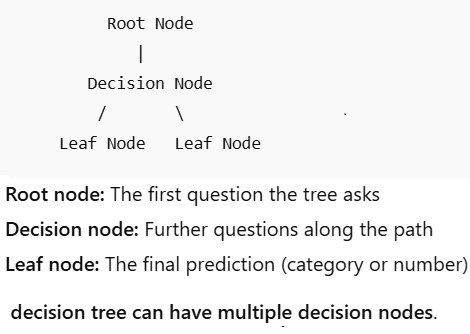
The decision tree is called that because it creates models for classification or prediction in the shape of a tree. It splits the data into smaller parts and connects each part with a decision. This makes a tree with decision points and final answers. A decision point can have two or more paths and leads to the final answers. A final answer shows the result of the classification or decision. It uses the if-then-else rule to make predictions. As you go deeper into the tree, the rules get more complicated, which makes the model more accurate. A decision tree has:
Root Node: The process starts at the top of the tree with the entire dataset.
Internal Nodes (Decision Nodes): At each internal node, the algorithm tests a specific attribute or feature to split the data into smaller, more homogeneous subsets.
Leaf Nodes (Terminal Nodes): The process ends at the leaf nodes, which represent the final decision, class label, or predicted continuous value.
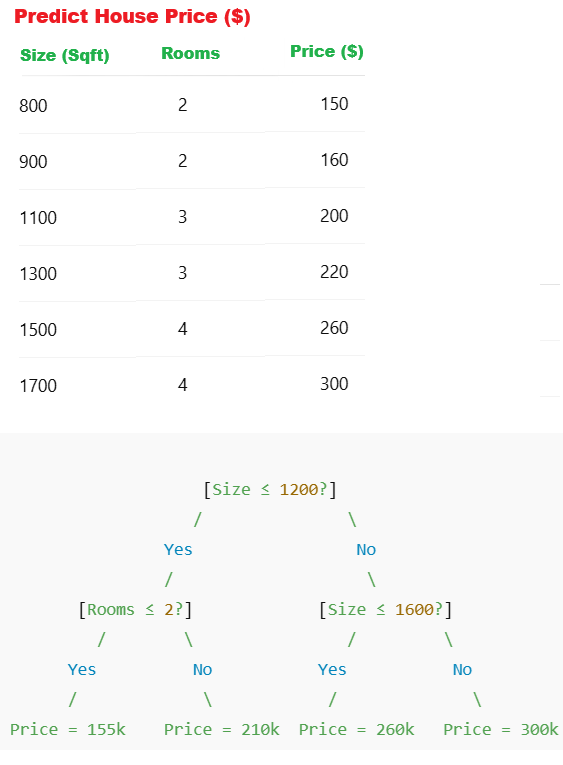
Let's see an example
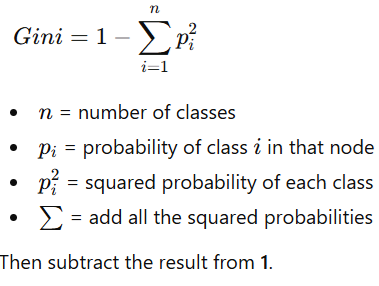
 Gini Impurity
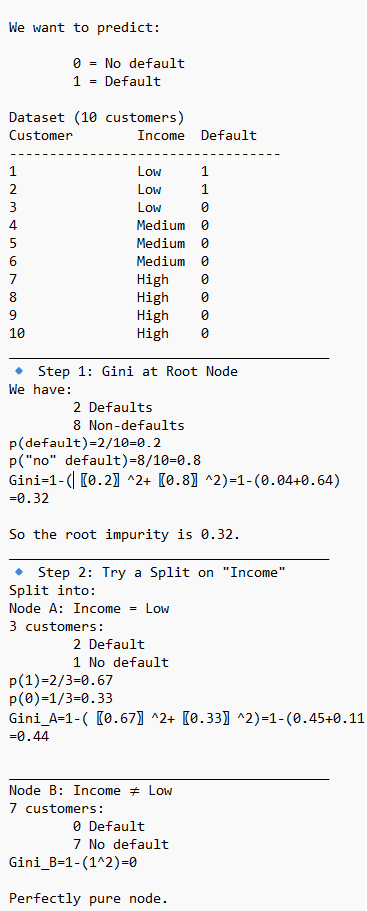
Gini Impurity is commonly used in Decision trees, Random Forest, primarily as the default criterion to measure the quality of splits in the individual classification trees. It calculates how frequently a randomly chosen element would be incorrectly labeled, guiding the algorithm to create pure, homogeneous nodes.
Node Splitting: During tree construction, the algorithm calculates the Gini Impurity for possible splits, choosing the one that minimizes impurity.
 USE CASE 1: Use Decision Trees with scikit-learn to predict whether a loan will default. Dependent variable: Default (0 = No Default, 1 = Default) Independent variables (3): Income (monthly income, e.g., 1000–10000) CreditScore (300–850) LoanAmount (1000–50000).
import numpy as np
import pandas as pd
from sklearn.model_selection import train_test_split
from sklearn.tree import DecisionTreeClassifier
from sklearn.metrics import accuracy_score, confusion_matrix, classification_report


# -----------------------------------
# 1. Load data from Excel
# -----------------------------------
data = pd.read_excel("loan_data.xlsx")
df = pd.DataFrame(data)
print("Dataset Preview:")
print(data.head())

# -----------------------------------
# 2. Define features and target
# -----------------------------------
X = df[["Income", "CreditScore", "LoanAmount"]]
y = df["Default"]

# -----------------------------------
# 3. Split into training and testing
# -----------------------------------
X_train, X_test, y_train, y_test = train_test_split(
    X, y, test_size=0.25, random_state=42, stratify=y
)

# -----------------------------------
# 4. Train the DecisionTree model
# -----------------------------------
model = DecisionTreeClassifier(
    criterion='gini',      # or 'entropy'
    max_depth=3,           # prevents overfitting
    random_state=42
)

model.fit(X_train, y_train)


Step 5: Evaluate the model
print("Accuracy:", accuracy_score(y_test, y_pred))
print("\nConfusion Matrix:\n", confusion_matrix(y_test, y_pred))
print("\nClassification Report:\n", classification_report(y_test, y_pred))


Step 6: Predict default for a new customer
new_customer = [[4500, 620, 16000]]  # Income, CreditScore, LoanAmount

default_prediction = model.predict(new_customer)
default_probability = model.predict_proba(new_customer)[0][1]

print("Default Prediction:", default_prediction[0])
print("Probability of Default:", default_probability)
USE CASE 2: Customer Churn example using Decision Trees with scikit-learn in Python. We’ll assume 4 independent variables, for example: Tenure (months with company) - 1–60 months MonthlyCharges (amount billed per month) - 30–120 ContractType (0=Month-to-month, 1=One-year, 2=Two-year) SupportCalls (number of calls to support) 0–10 The dependent variable is Churn (0=Stay, 1=Churn)..
import numpy as np
import pandas as pd
from sklearn.model_selection import train_test_split
from sklearn.tree import DecisionTreeClassifier
from sklearn.metrics import accuracy_score, confusion_matrix, classification_report


# -----------------------------------
# 1. Load data from Excel
# -----------------------------------
#sample data can be exported to
#excel from the URL
# https://www.pythonplaza.com/categorical_customer_churn_1_or_0.html

data = pd.read_excel("customer_data.xlsx")

print("Dataset Preview:")
print(data.head())

# -----------------------------------
# 2. Define features and target
# -----------------------------------
X = df[["Tenure", "MonthlyCharges", "ContractType", "SupportCalls"]]
y = df["Churn"]

# -----------------------------------
# 3. Split into training and testing
# -----------------------------------
X_train, X_test, y_train, y_test = train_test_split(
    X, y, test_size=0.25, random_state=42
)

# -----------------------------------
# 4. Train the DecisionTree model
# -----------------------------------
model = DecisionTreeClassifier(
    criterion='gini',      # or 'entropy'
    max_depth=3,           # prevents overfitting
    random_state=42
)

model.fit(X_train, y_train)


Step 5: Evaluate the model
print("Accuracy:", accuracy_score(y_test, y_pred))
print("\nConfusion Matrix:\n", confusion_matrix(y_test, y_pred))
print("\nClassification Report:\n", classification_report(y_test, y_pred))

# -----------------------------------
# Evaluate the model
# -----------------------------------
print("Accuracy:", accuracy_score(y_test, y_pred))
print("\nConfusion Matrix:\n", confusion_matrix(y_test, y_pred))
print("\nClassification Report:\n", classification_report(y_test, y_pred))


#Predict churn for a new customer
new_customer = [[8, 92, 0, 5]]
# Tenure, MonthlyCharges, ContractType, SupportCalls

churn_prediction = model.predict(new_customer)
churn_probability = model.predict_proba(new_customer)[0][1]

print("Churn Prediction:", churn_prediction[0])
print("Probability of Churn:", churn_probability)

#Interpreting the results (business view)
1 → High risk of churn ⚠️

0 → Likely to stay ✅

Use probability (e.g., churn > 0.6) to trigger retention offers
USE CASE 3: Use Decision Trees to determine what learning style a student prefers -
Visual, Auditory, Reading/Writing, Kinesthetic (Dependent Variable)
Independent variables (How a student prefers to learn)
prefers_diagrams – How much a student likes diagrams (1-5)
prefers_lectures – How much a student likes lectures (1-5)
prefers_notes – How much a student likes reading/writing notes (1-5)
prefers_hands_on – How much a student likes hands-on activities (1-5)
import numpy as np
import pandas as pd
from sklearn.model_selection import train_test_split
from sklearn.tree import DecisionTreeClassifier
from sklearn.metrics import accuracy_score, confusion_matrix, classification_report


# -----------------------------------
# 1. Load data from Excel
# -----------------------------------
#sample data can be exported to
#excel from the URL


  Get the Categorical learning Styles data in Excel


data = pd.read_excel("Categorical_learning_Styles.xlsx")

print("Dataset Preview:")
print(data.head())

# -----------------------------------
# 2. Define the data
# -----------------------------------
X = df[['prefers_diagrams', 'prefers_lectures',
        'prefers_notes', 'prefers_hands_on']]

y = df['learning_style']

# Encode categorical target labels
le = LabelEncoder()
y_encoded = le.fit_transform(y)

# -----------------------------
# 3. Train-Test Split
# -----------------------------
X_train, X_test, y_train, y_test = train_test_split(
    X, y_encoded, test_size=0.3, random_state=42
)

# -----------------------------------
# 4. Train the DecisionTree model
# -----------------------------------
model = DecisionTreeClassifier(
    criterion='gini',      # or 'entropy'
    max_depth=3,           # prevents overfitting
    random_state=42
)

model.fit(X_train, y_train)


Step 5: Evaluate the model
print("Accuracy:", accuracy_score(y_test, y_pred))
print("\nConfusion Matrix:\n", confusion_matrix(y_test, y_pred))
print("\nClassification Report:\n", classification_report(y_test, y_pred))

# -----------------------------------
# Evaluate the model
# -----------------------------------
print("Accuracy:", accuracy_score(y_test, y_pred))
print("\nConfusion Matrix:\n", confusion_matrix(y_test, y_pred))
print("\nClassification Report:\n", classification_report(y_test, y_pred))


#Predict with sample data
new_students = np.array([
    [5, 1, 2, 1],  # Likely Visual
    [1, 5, 3, 2],  # Likely Auditory
    [2, 1, 5, 2],  # Likely Reading/Writing
    [1, 2, 1, 5]   # Likely Kinesthetic
])

# Predict encoded labels
predictions_encoded = model.predict(new_students)

# Convert numeric predictions back to original labels
predictions = le.inverse_transform(predictions_encoded)

print("Predicted Learning Styles:")
print(predictions)
USE CASE 4: Use Decision Trees to predict if a person has a disease. Age, BloodPressure,Cholesterol,FamilyHistory are independent variables, and Disease is a dependent variable.
import numpy as np
import pandas as pd
from sklearn.model_selection import train_test_split
from sklearn.tree import DecisionTreeClassifier
from sklearn.metrics import accuracy_score, confusion_matrix, classification_report


# -----------------------------------
# 1. Load data from Excel
# -----------------------------------
#sample data can be exported to
#excel from the URL


  Get Disease Classification in Excel


data = pd.read_excel("patient_dosage_response.xlsx")

print("Dataset Preview:")
print(data.head())

df = pd.DataFrame(data)

# ----------------------------------
# 2. Separate Features and Target
# ----------------------------------
X = df[['Age', 'BloodPressure', 'Cholesterol', 'FamilyHistory']]
y = df['Disease']

# ----------------------------------
# 3. Train-Test Split
# ----------------------------------
X_train, X_test, y_train, y_test = train_test_split(
    X, y, test_size=0.3, random_state=42
)

# -----------------------------------
# 4. Train the DecisionTree model
# -----------------------------------
model = DecisionTreeClassifier(
    criterion='gini',      # or 'entropy'
    max_depth=3,           # prevents overfitting
    random_state=42
)

model.fit(X_train, y_train)


Step 5: Evaluate the model
print("Accuracy:", accuracy_score(y_test, y_pred))
print("\nConfusion Matrix:\n", confusion_matrix(y_test, y_pred))
print("\nClassification Report:\n", classification_report(y_test, y_pred))

# -----------------------------------
# Evaluate the model
# -----------------------------------
print("Accuracy:", accuracy_score(y_test, y_pred))
print("\nConfusion Matrix:\n", confusion_matrix(y_test, y_pred))
print("\nClassification Report:\n", classification_report(y_test, y_pred))

# New patient data
# Format: [Age, BloodPressure, Cholesterol, FamilyHistory]

new_patients = np.array([
    [45, 150, 230, 1],  # High risk
    [28, 118, 175, 0]   # Low risk
])

predictions = model.predict(new_patients)

print("Disease Predictions:")
print(predictions)
About Us | Contact Us | Sitemap | Privacy Policy